

William Conlon
The Gray Cycle
Essay by Robert M. Murdock
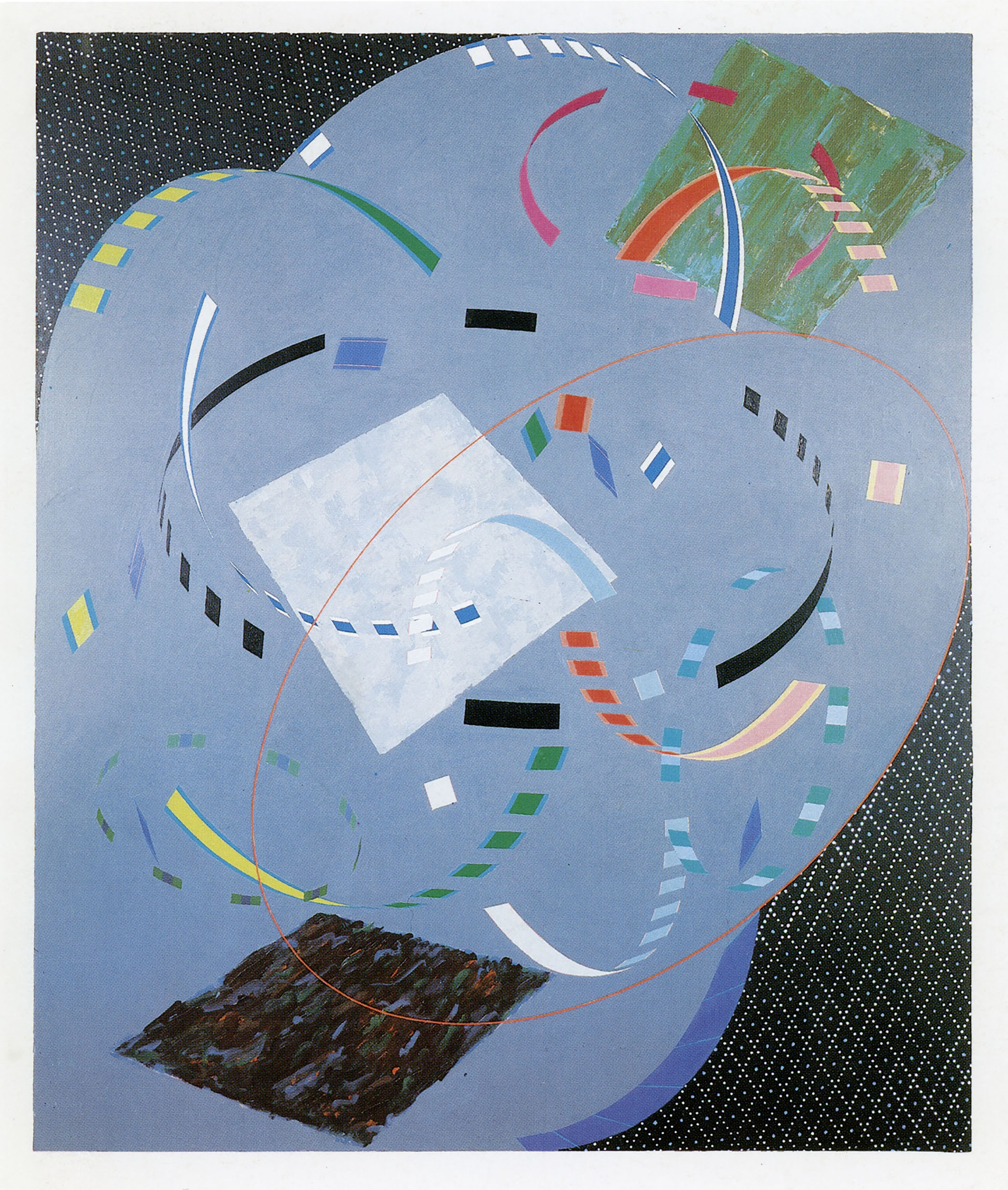
Cover: Conversation in a Rain Forest, 1983. Acrylic on canvas, 7'2" x 6' (218 x 182 cm)
André Emmerich Gallery
41 East 57th Street, New York 10022 · Telephone (212) 752-0124
January 30 – February 23, 1985
Preview Wednesday, January 30, from 5 to 7 p.m.
William Conlon
In his 1983-84 paintings, William Conlon has synthesized elements which have persisted in his work for the past fifteen years. These include the creation of an animated abstract space, inhabited by a complex interaction of lines, planes and surface pattern; a carefully worked-out ground, closely interwoven with and inseparable from the forms which appear to be on or underneath it; an illusion of motion; and a sense of orchestration of the whole. Also persistent, if secondary, in Conlon's work since 1970 is a compendium of pictorial elements, an ongoing definition and redefinition of the vocabulary of non-objective painting. His imagery often alludes to earlier 20th century art – the work of Kandinsky, Malevich or Picasso, for example – or to more recent painters such as Still or Johns. But Conlon's pictorial repertoire represents more than an ironic commentary about the history of abstract painting; it is a personal vocabulary which he has evolved and refined for his exploration of abstract space.
To the viewer who has been familiar with Conlon's work of the past few years – highly complex, dense compositions of overlapping planes, arcs and pinwheel shapes in strong colors – these new paintings may seem spare and cool by comparison. The shell-like white ground which has been present in varying degrees since the mid-1970s has given way to different hues of gray, and while the interrelation of line and plane is still complex, the overall effect is more open, lyrical. In contrast to the flat, planar space in The Blues Brothers diptych, 1979, or Sunset City, 1980, for example, recent paintings such as Slam Dance, 1983, suggest a deeper elliptical space. The forms in the paintings seem to whirl through space in circular patterns; the centrifugal motion is broken or countered by jagged crossing diagonals, like "check-marks" in the indeterminate void. Recalling his large white-ground canvases of the early 1970s, Conlon, in the gray paintings, allows the field to assert itself as an arena for the activity of the painting, as opposed to some late 70s examples in which the white ground was secondary to larger planes of color and pattern. As in his cerebral white paintings of the mid-70s (e.g. Einstein's Waltz II or 20th Century Limited, 1976), recent works such as Blue Shift, 1983, present spatially ambiguous relationships and unexpected discontinuities. One may follow a line which appears to go under the surface plane, then reappear; but often an illogical or impossible situation confounds one's initial reading. This kind of participation and effort on the part of the spectator is important in fully experiencing the work.
Conlon is actively contemporary in attitude and keenly interested in advanced mathematics and physics, computer technology, video games (Pac-man et al.) and other icons of the 80s. The spatial possibilities of computer graphics fascinate him, though he has not actually used a computer in working out the elaborate permutations of line and space in his painting. As early as 1971 he stated that a film illustrating the speed of light was more relevant to the kind of space he was interested in than were any aesthetic theories or formalist criticism of that time.* Yet he also believes in the element of composition, though he admits it is out of fashion – for example, Cubist space created through fragmentation and overlapping. He cites Picasso's Synthetic Cubist painting Harlequin and Woman with a Necklace, 1917 (Centre Georges-Pompidou, Paris) as having been an important inspiration for the recent work; he saw this Picasso in the major exhibition, "The Essential Cubism 1907–1920" at The Tate Gallery, London, in the summer of 1983. In the Picasso work, the paired figures are presented in a restrained palette of blue, black and white against a gray ground; the border and a few areas within the composition are defined with the dot pattern that frequently appears in Picasso's later Cubist paintings. Conlon's recent gray paintings reveal a similar fragmentation and opposition of black and white planes on a gray ground, and the edges and corners often contain cross-hatched or stencilled dot patterns. But to continue this comparison would give it too much significance; since Conlon's work is neither dependent upon nor derivative of earlier abstraction. While he acknowledges his debt to early geometric abstraction and Constructivism, he notes sardonically that no artist "owns the rights to the square or triangle." He feels that the pioneering work of Malevich and Mondrian was only a beginning: they were still working within the limitations of easel painting, and their view of the modern world was primitive, as "seen from a blimp rather than a satellite." The history of art since 1950, with the assertion of the large canvas in abstract expressionist painting, along with advancements in science and technology, afford an unprecedented opportunity to expand and build upon the basic vocabulary of non-objective art.
Conlon sees his 1981 work, The Helicopter Ride, as marking the beginning of the gray paintings; it was also significant as an embodiment of his space-time concerns. The piece consists of four individual panels, each 34 x 30", hung a few inches apart in step fashion, each slightly higher than the panel next to it. In tandem with this physical suggestion of ascension into space, the images within the painting convey the shifting and receding of planes and diminution of size which one would perceive in a helicopter take-off: the analogy could be extended to suggest views of the earth from spacecraft or satellite, a kind of image which fascinates Conlon in its simultaneity of an abstract image through time and space. When first shown, The Helicopter Ride was installed on a gray wall, very close in hue to the gray used in some of the current paintings. Conlon has integrated the essential aspects of this earlier effort in the new work: the gray background; the separation of individual elements within the whole; and multiple spatial viewpoints and situations within one work. Conlon saw Helicopter Ride as an effort "to find a new format, to pull the work out into a new space."
The choice of gray, too, was a search for something different after more than ten years of working with the pure white ground: gray was an unknown, and could be ominous. In the past few years, Conlon has become more aware of the subtlety and degrees of grayness which can be achieved by varying amounts of blue or yellow, as well as of black and white. Whereas gray may intensify color, he notes that it can also "kill" or absorb color; but the use of the gray ground has enabled Conlon to "push color further than I've ever experienced it." He may change the whole ground color, making it warmer or cooler in relation to the other colors in the painting. Color values of individual planes are also adjusted in relation to each other, as in Slam Dance, creating an illusion of changing light through space.
The new paintings are much more intuitive and direct than the more tightly structured paintings such as The Blues Brothers of a few years ago. Conlon remarks that with the earlier work he knew how the painting was going to look before he started; but in the current paintings he does not always know what form they may take. Whereas he used assistants in the previous work, the new paintings are "very solitary, done by hand." Conlon spends a long time drawing on the canvas, familiarizing himself with the surface, shapes and relationships, before beginning to paint. After about a month of drawing, the composition "starts to freeze"; then once the graphic elements are resolved his energies are focused on interaction of color and surface. Each work, he says, is about a different thing and different feelings, which the titles suggest; but all reflect the pace and often chaotic activity of contemporary life. As in The Blues Brothers (which he considers figurative paintings) the gray paintings, such as Slam Dance and The Last Dance of the Whirling Dervish, are "about dance today" – its rhythms and energy.
As well as responding to contemporary life and culture, Conlon frequently mentions music in relation to his work – rhythmic structure, interweaving of shapes and repetition of themes could be seen as analogous to the harmonic structure of Philip Glass's music, for example. The motion within the paintings also suggests sound – percussion, or the insistent repeated tones of Glass's compositions.
These new paintings reflect a logical development of ideas Conlon has been working with for more than fifteen years, and the continuing cycle in his work from simple to highly complex to a synthesis of the two. The resolution of formal and spatial problems in the gray ground paintings is informed with the clear logic and intelligence that has always characterized Conlon's art.
Robert M. Murdock
Chief Curator, Walker Art Center
Reprinted with the permission of Arts magazine
The quotes are from a taped interview with the artist, Minneapolis, July 11, 1984
* In Four New York Painters: Conlon, Cote, Hacklin, Rafoss, exhibition catalogue, Dallas Museum of Fine Arts, 1971.
Plates
The Gray Cycle
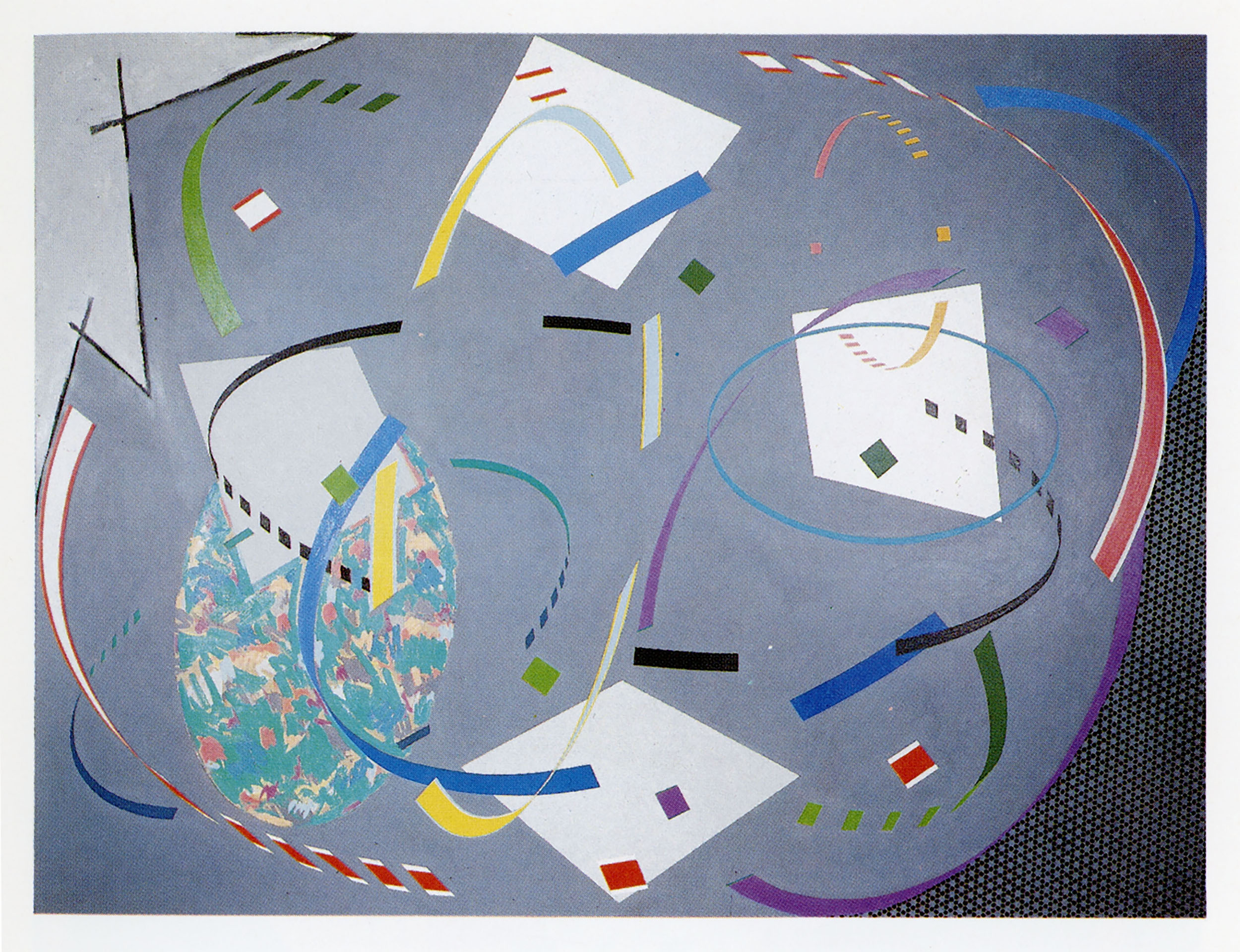
1. Slam Dance, 1983. Acrylic on canvas, 7'6" x 10' (228 x 304 cm)
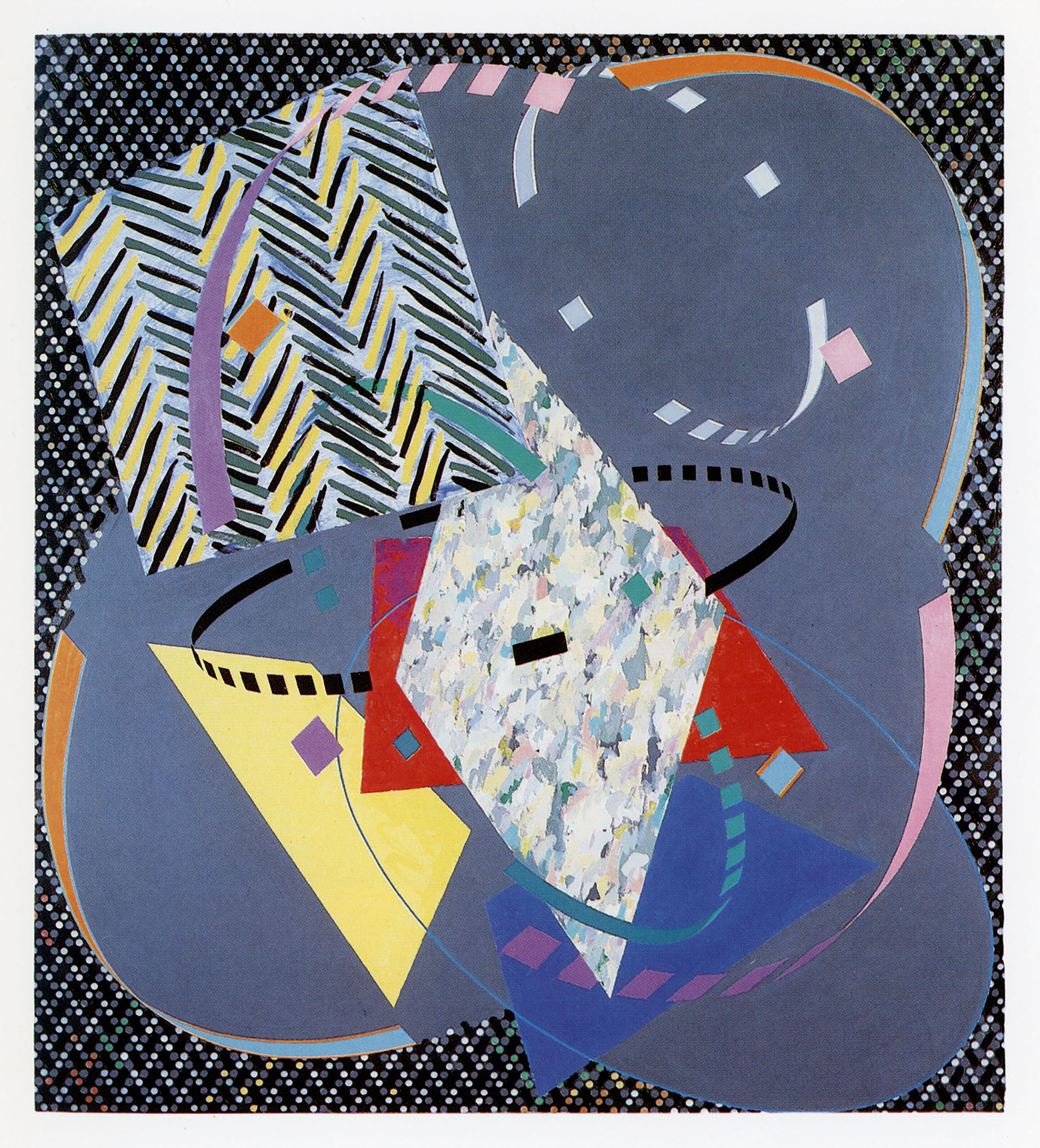
2. South of the Border, 1984. Acrylic on canvas, 5' x 4'6" (152 x 137 cm)
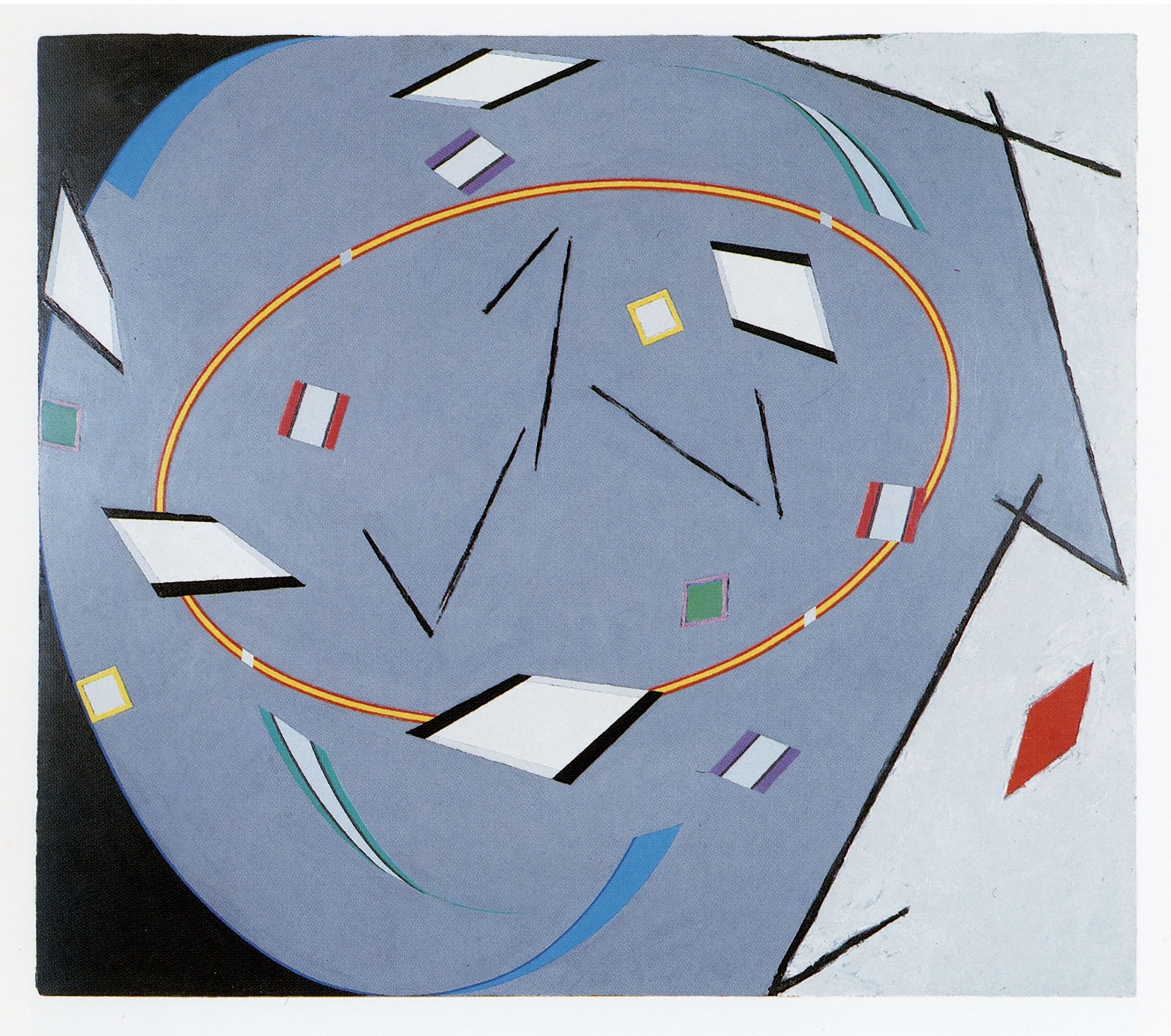
3. Time Glider 1, 1982–83. Acrylic on canvas, 3'8" x 4'2" (111 x 127 cm)
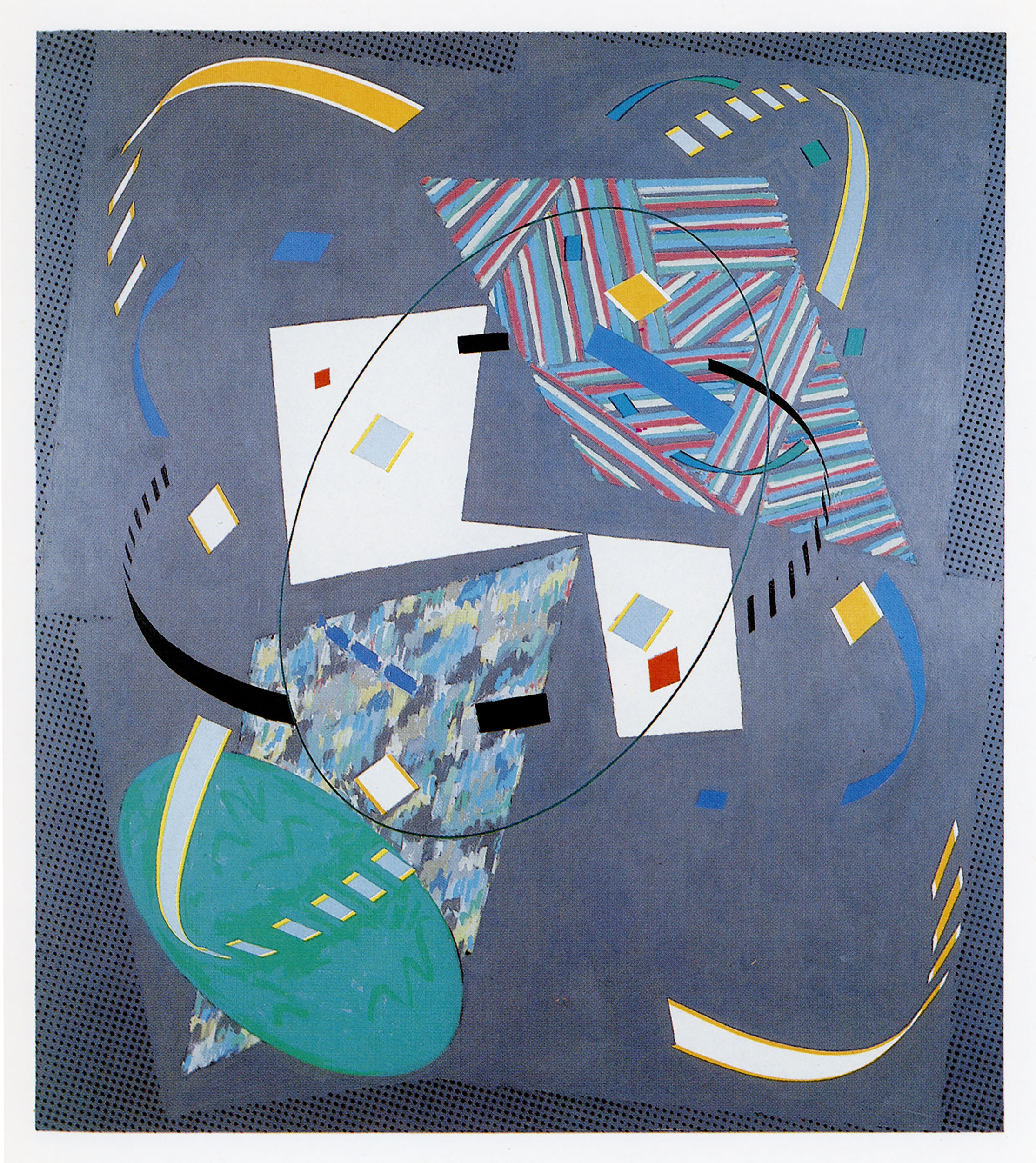
4. Time Glider 2, 1983. Acrylic on canvas, 6' x 5'4" (182 x 162 cm)
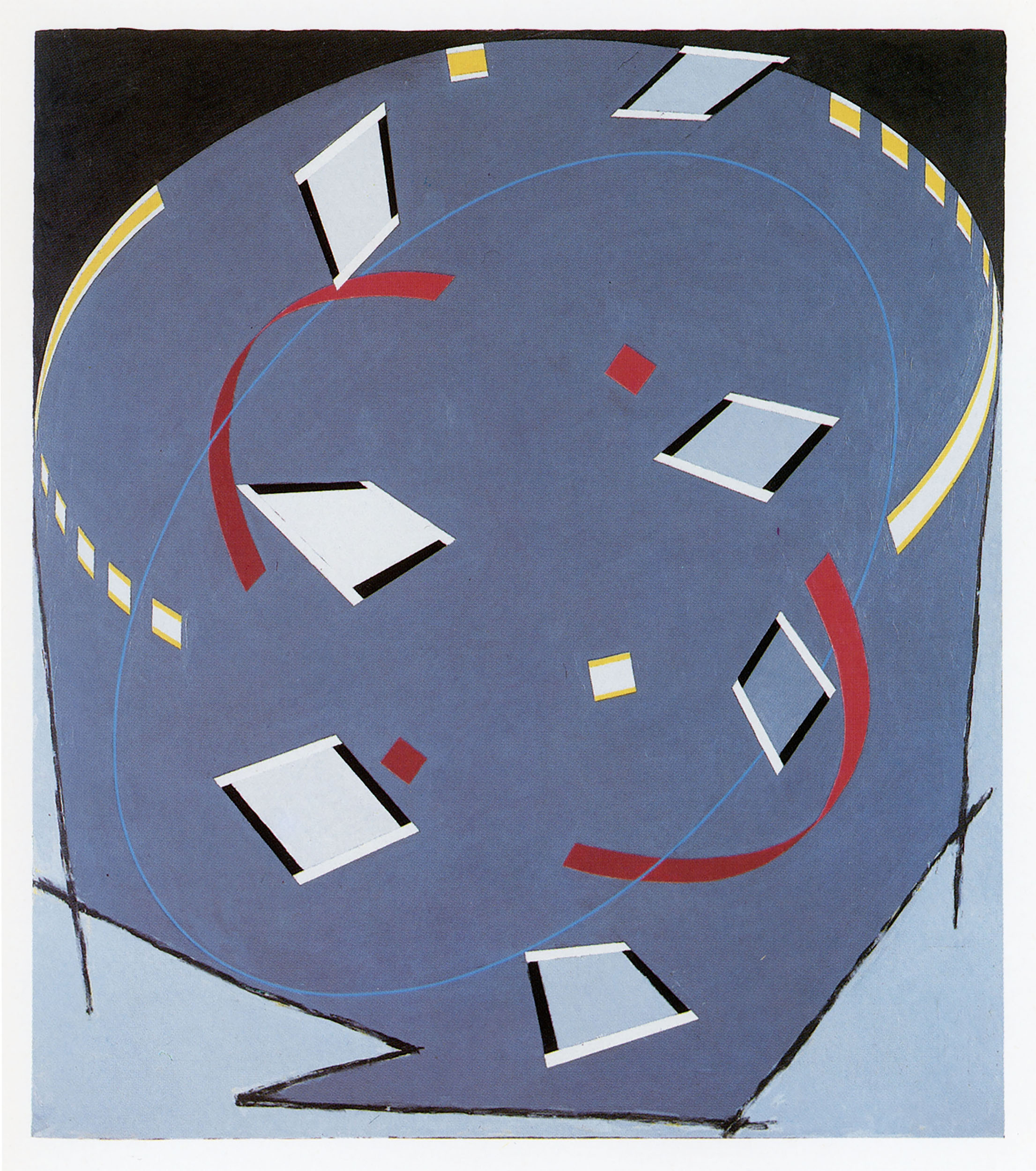
5. Time Glider 3, 1984. Acrylic on canvas, 4'2" x 3'8" (127 x 111 cm)
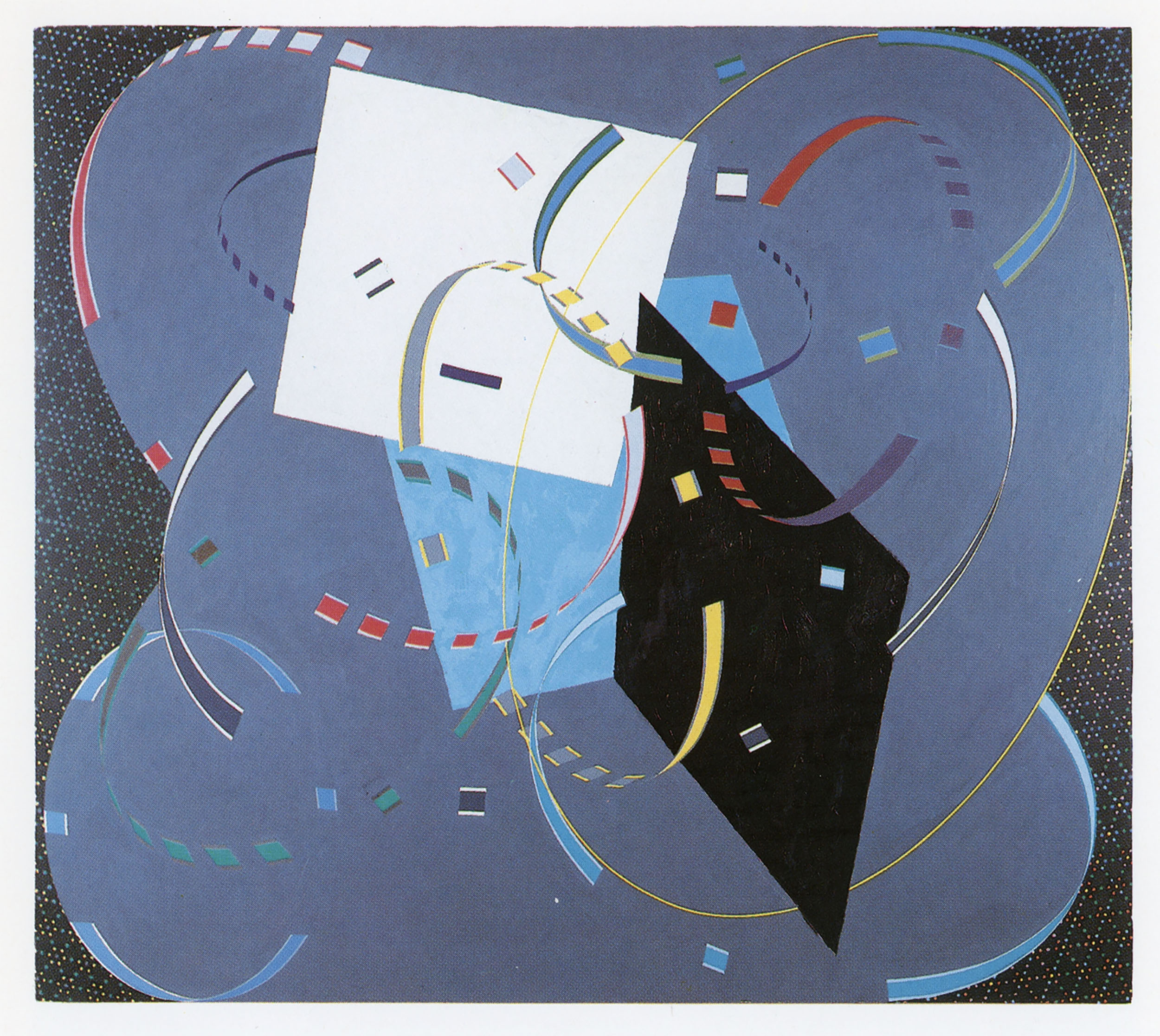
6. Blue Shift, 1984. Acrylic on canvas, 5'4" x 6' (162 x 182 cm)
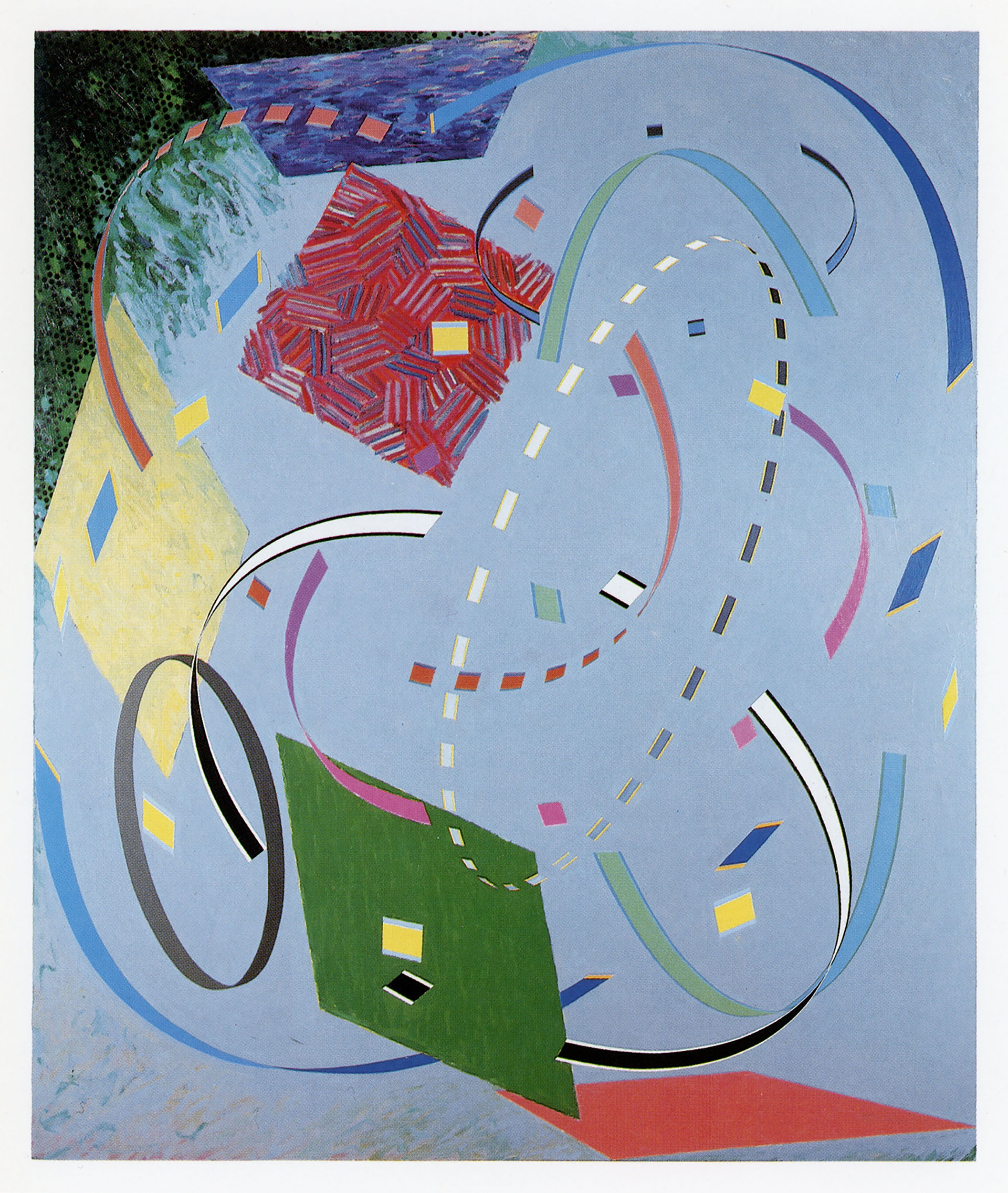
7. Los Alamos Speedway, 1984. Acrylic on canvas, 7'2" x 6' (218 x 182 cm)
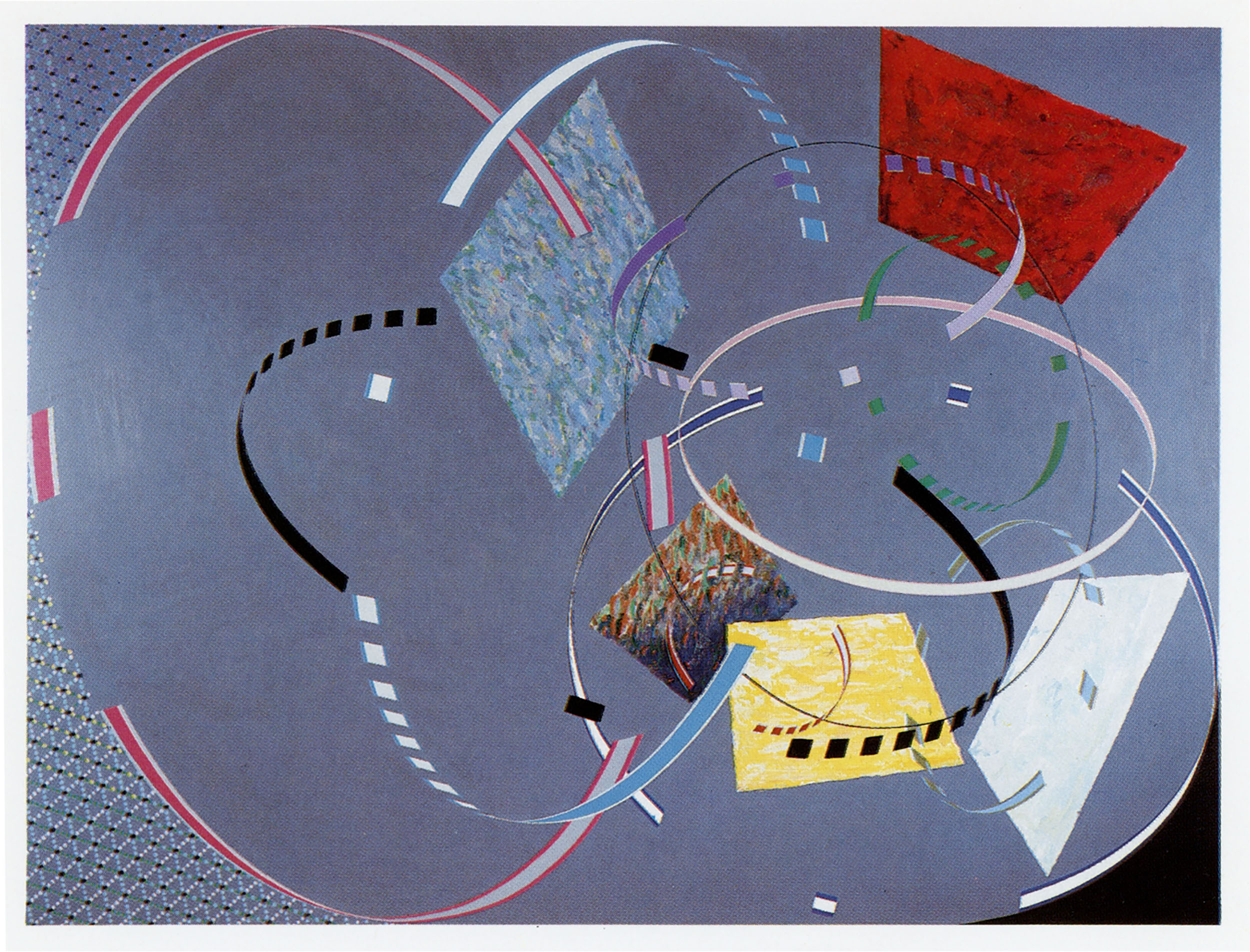
8. The Last Dance of the Whirling Dervish, 1984. Acrylic on canvas, 7'6" x 10' (228 x 304 cm)
Biographical notes
William Conlon was born in Albany, New York, in 1941. He was educated at the School of Visual Arts and the School of Art & Architecture, Yale University. He now lives in New York City.
One-Man Exhibitions
Selected Public Collections
Dallas Museum of Fine Arts, Dallas, Texas
Everson Museum of Art, Syracuse, New York
Grand Rapids Art Museum, Grand Rapids, Michigan
Brooklyn Museum, Brooklyn, New York
International Business Machines
Sherman & Sterling, New York
First National City Bank, Houston
Albright-Knox Art Gallery, Buffalo, New York
Awards
Bibliography
1970
Gollin, Jane. "Reviews and Previews: Conlon at Reese Palley," Art News, December 1970, pp. 14–16.
Pincus-Witten, Robert. "New York," Artforum, December 1970, p. 76.
Ratcliff, Carter. "New York Letter: Exhibition at Reese Palley," Art International, December 1970, pp. 69–70.
1971
Robbin, Tony. "A Protean Sensibility," Arts Magazine, May 1971, pp. 28–30.
Four New York Painters, Dallas Museum of Fine Arts, 1971; introduction by Robert Murdock.
Four Painters, Hathorn Gallery, Skidmore College, Saratoga Springs, New York, 1971; preface by George F. Kuebler.
1972
Ratcliff, Carter. "The Whitney Annual, Part I," Artforum, April 1972, pp. 28–32.
Rose, Barbara. "Art: William Conlon," New York Magazine, April 17, 1972, p. 89.
Contemporary American Painting 1972, Whitney Museum of American Art, New York, 1972; foreword by John I. H. Baur.
1975
34th Biennial of Contemporary American Painting, Corcoran Gallery of Art, Washington, D.C., 1975; introduction by Roy Slade.
1977
Lubell, Ellen. Review, School of Visual Arts, Arts Magazine, October 1977, p. 26.
Robbin, Tony. "The New Art of 4-Dimensional Space: Spatial Complexity in Recent New York Work," Artscribe, November 1977.
1978
Meltzer, Herbert. "The Unexpected," The Sciences (New York Academy of Sciences), March 1978.
Zimmer, William. Review, New York Academy of Sciences, Soho Weekly News, April 13, 1978.
1979
Russell, John. New York Times, February 9, 1979, p. C24.
Rose, Barbara. American Painting: The Eighties, A Critical Interpretation, exhibition catalogue, Grey Art Gallery and Study Center, New York University, New York, 1979.
Lubell, Ellen. Review, "Generation: Twenty Abstract Painters Born in the U.S. Between 1929 and 1946," Soho Weekly News, February 22, 1979.
Perreault, John. Review, Grey Art Gallery, Soho Weekly News, September 27, 1979, p. 59.
Smith, Roberta. Review, "American Paintings: The Eighties," Art in America, October 1979, pp. 122–23.
Tennant, Donna. "Technique Preoccupies Painters in Lee Gallery Show," Houston Chronicle, October 12, 1979.
Tennant, Donna. "Art and the Critical Dilemma of Content," Houston Chronicle, October 28, 1979.
Foster, Hal. "A Tournament of Rose's," Artforum, November 1979, pp. 62–67.
1980
Perreault, John. Review, Pratt Manhattan Center, Soho Weekly News, January 24, 1980, p. 23.
Larson, Kay. Review, Pratt Manhattan Center, Village Voice, January 28, 1980, p. 72.
Schwartz, Ellen. Subject: Space, exhibition catalogue, Pratt Institute, Brooklyn and Manhattan, 1979.
Murry, Jesse. "William Conlon," Arts Magazine, February 1980, p. 14.
Frank, Elizabeth. "William Conlon at Emmerich," Art in America, April 1980, pp. 131–33.
Michel, Jacques. "Artistes américains pour 1980," Le Monde, April 23, 1980, p. 1.