

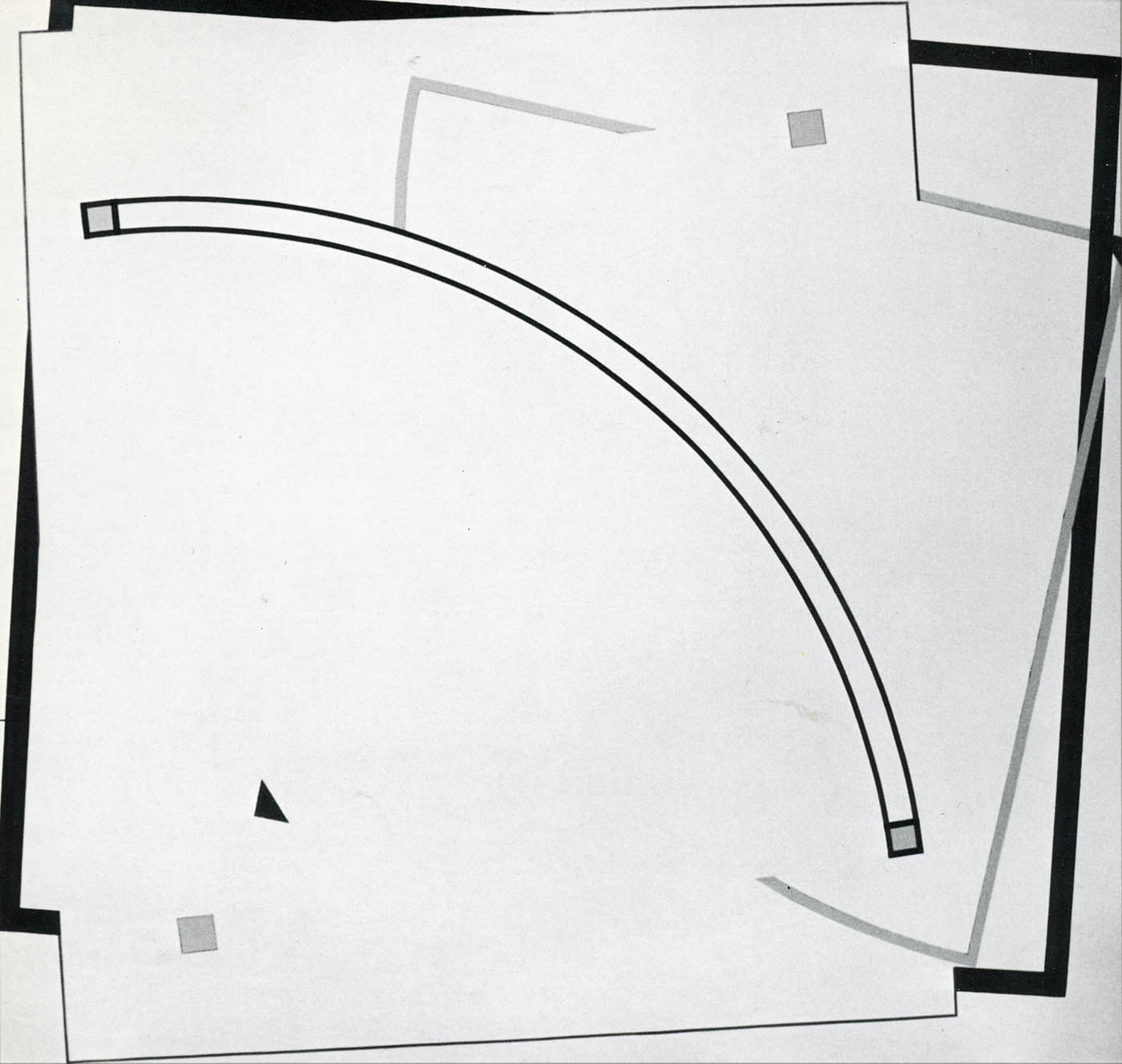
William Conlon, EINSTEIN'S WALTZ, 1974, acrylic on canvas
From Pongto Pac-Man
November 14, 1982 — January 2, 1983
De Cordova Museum · Lincoln, Massachusetts
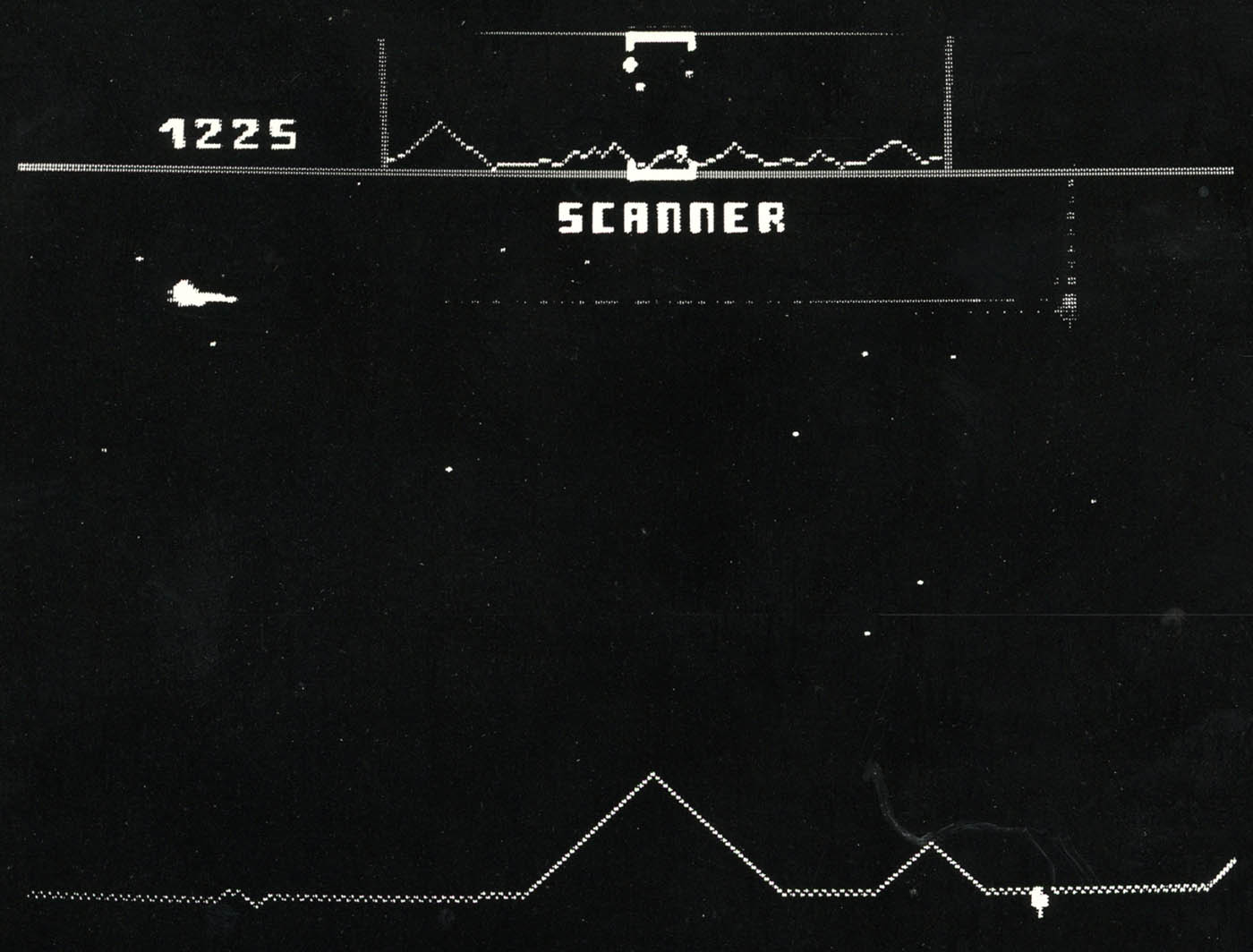
DEFENDER, © 1980, Williams Electronics
Foreword
There can be little doubt that video games have become an obsession of awesome proportions. Pac-Man appears on the cover of Time magazine, in network news, greeting cards and candy stores. The word "fad" is too weak to express the penetration of this phenomenon. The DeCordova's current exhibition is a modest attempt to provide a few aesthetic handles on the art form of video games, a form that changes each month as new devices are developed and as users' passions shift with the seasons. Even in the three months since our exhibition was announced, the Pac-Man arcade game has slipped from 3rd to 12th place in popularity lists of arcade games.
The task of providing some kind of focus on this rapidly changing scene has fallen on the capable shoulders of the DeCordova's Assistant Curator, David Joselit. His combined skills as an art historian and critic of contemporary art have served him well in choosing artists and establishing meaningful resonances between games and paintings. We are also grateful to Coleco Industries in Hartford for providing video game hardware for this exhibition. Similarly, we would like to thank Atari, Inc. for providing useful assistance; Woburn Vending for arcade machines; and most importantly, our lenders of art work: Jerrold A. Basofin, Chicago; artist William Conlon, New York City; The André Emmerich Gallery, New York City; Phyllis Kind Gallery, New York City and Chicago; Loretta and Robert Lifton, New York City; The Whitney Museum of American Art, New York City. We are particularly grateful to Holly Solomon and Phyllis Kind for their assistance in arranging loans for the exhibition.
The DeCordova staff has added their significant talents to this undertaking in the form of photography by Eric Shambroom, graphic design by Stephen Sakowich and Janice Kasiecki; typesetting by Joan Kennedy; and project management and coordination by Laurie Lingham, our Assistant Curator and Registrar. Lastly, we would like to thank the Massachusetts Council on the Arts and Humanities for funding support and WNEV, Boston, and Mugar Communications for making video material available for our audio visual presentation.
Television activates the child at the same time that it cuts the child (or adult) off from real sensory stimulation and the opportunity for resolution.1
Jerry ManderFor better or worse…these motor coordination tests have become in the space of a mere couple of years, probably the greatest cultural force among the youth of the western world.2
Erik Sandberg-DimentNo longer can we possibly consider Pac-Man to be a mere video game image. This hungry yellow jaw has become a world-wide celebrity.3
The Editors of Consumer Guide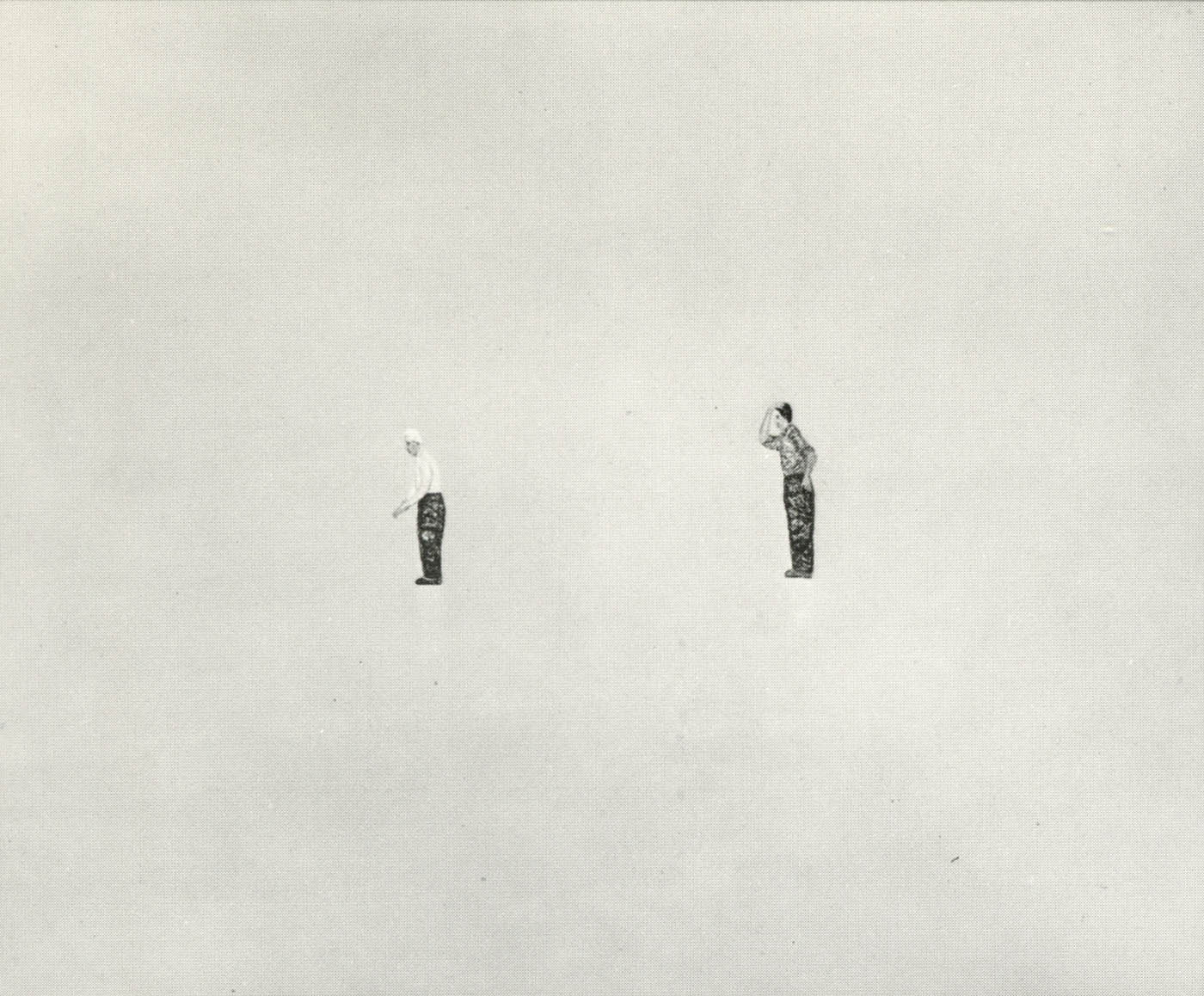
Nicholas Africano, AN ARGUMENT, 1977, acrylic, oil and wax on canvas, 69 inches x 85½ inches, Collection of Whitney Museum of American Art, Gift of Mr. and Mrs. William A. Marsteller
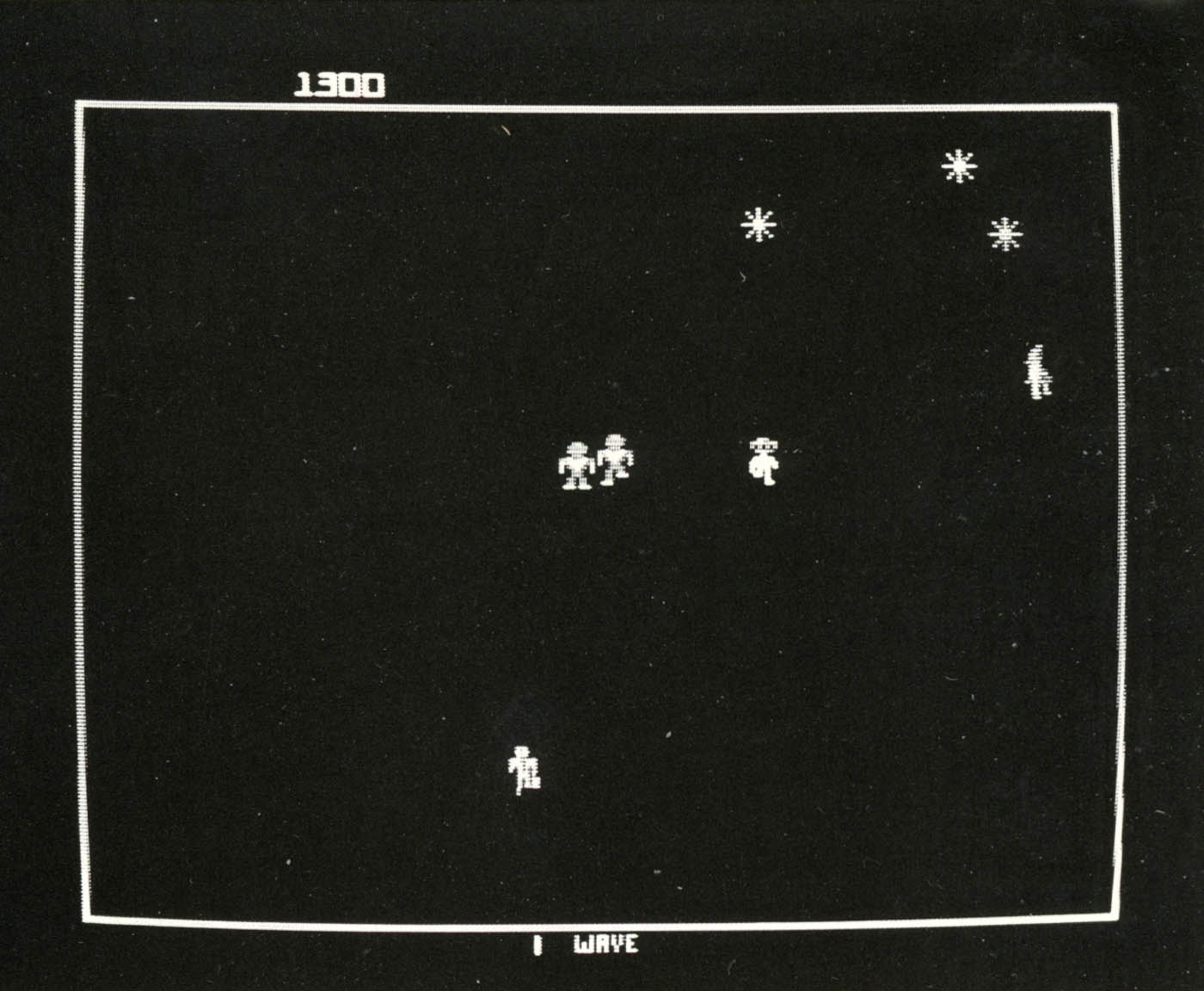
ROBOTRON, © 1982, Williams Electronics
Video games have entered the realm of theatre. In the course of their short history, the games have evolved from mute and schematic puzzles to engaging narratives inviting participation. Sophisticated storylines, realistic settings and complex movement have created the illusion of participatory television — inviting the player to become protagonist in a video story. The success and magnitude of the phenomenon is dramatically brought home by video game revenues in 1981: some $5.7 billion as compared to the $3 billion spent for movie tickets in the same year.4
The astonishing success of video games has been the source of amusement and concern among parents, town governments and sociologists. "From Pong to Pac-Man" is an attempt to provide a visual analysis of the phenomenon: to treat it as a folk art. At any moment in the history of art, vision is influenced simultaneously by fashion and transcendent values. It is a fact of life for artists today that fine art must exist amidst a particularly arresting and exciting context of popular imagery: a large part of which derives from the video game and its passive partner, television. Relevance in the arts comes from a feeling of currency which is partly created by acknowledging the visual phenomena of a time — either by rejecting them, or bending them to an artist's conception. This is why we have chosen paintings by three well-known contemporary artists to exhibit in conjunction with working video games. Each of these painters exemplifies a landscape paradigm with striking analogues in the video vernacular: Nicholas Africano's "screen-scape," Roger Brown's "pattern-scape," and William Conlon's "line-scape."
As the video game has developed, so has the sophistication of both its illusionism and its participatory drama. Atari's Pong was the first commercially successful game, introduced in 1972. Pong was a schematic version of ping pong in which two players operated video "paddles" running on vertical axes. The game appropriated an already popular and easy to play contest: the machine served only as a reminder of a ping pong table.
In 1976 Atari introduced another successful game, Breakout, which is technically reminiscent of Pong, but more advanced in terms of narrative content. The goal in Breakout is to shoot through a thick wall consisting of several rows of differently colored bricks. As in Pong, movement is restricted to a vertical axis, but here, the skillful operation of the game — which was the sole objective of Pong — is augmented by a "literary" motivation: breaking out of prison. This video game gives the player a competitive identity. Moreover, successful completion of the contest carries with it a visual prize: the game ball oscillates frenetically once the wall is penetrated.
In Breakout, the player battles against a static environment established by the game. Pac-Man, introduced by Midway Manufacturing in 1980, was the first compelling combination of an active protagonist battling an equally active antagonist. Pac-Man is a bonafide melodrama which is the model for more elaborate games subsequently developed. In this game action is given a great deal of realism through multi-directional movement within the confines of a maze; and the engaging, if overly cute character of Pac-Man who pursues and is pursued by four ghost-like creatures. The visual reward for good performance is increased in Pac-Man. When one maze is completed, a different one is presented after a short "intermission" consisting of a chase scene between Pac-Man and his antagonists, set to a musical accompaniment.
Several of the most recent games include a written teaser establishing the role of the player. Robotron is stylistically simple, but dramatically complex:
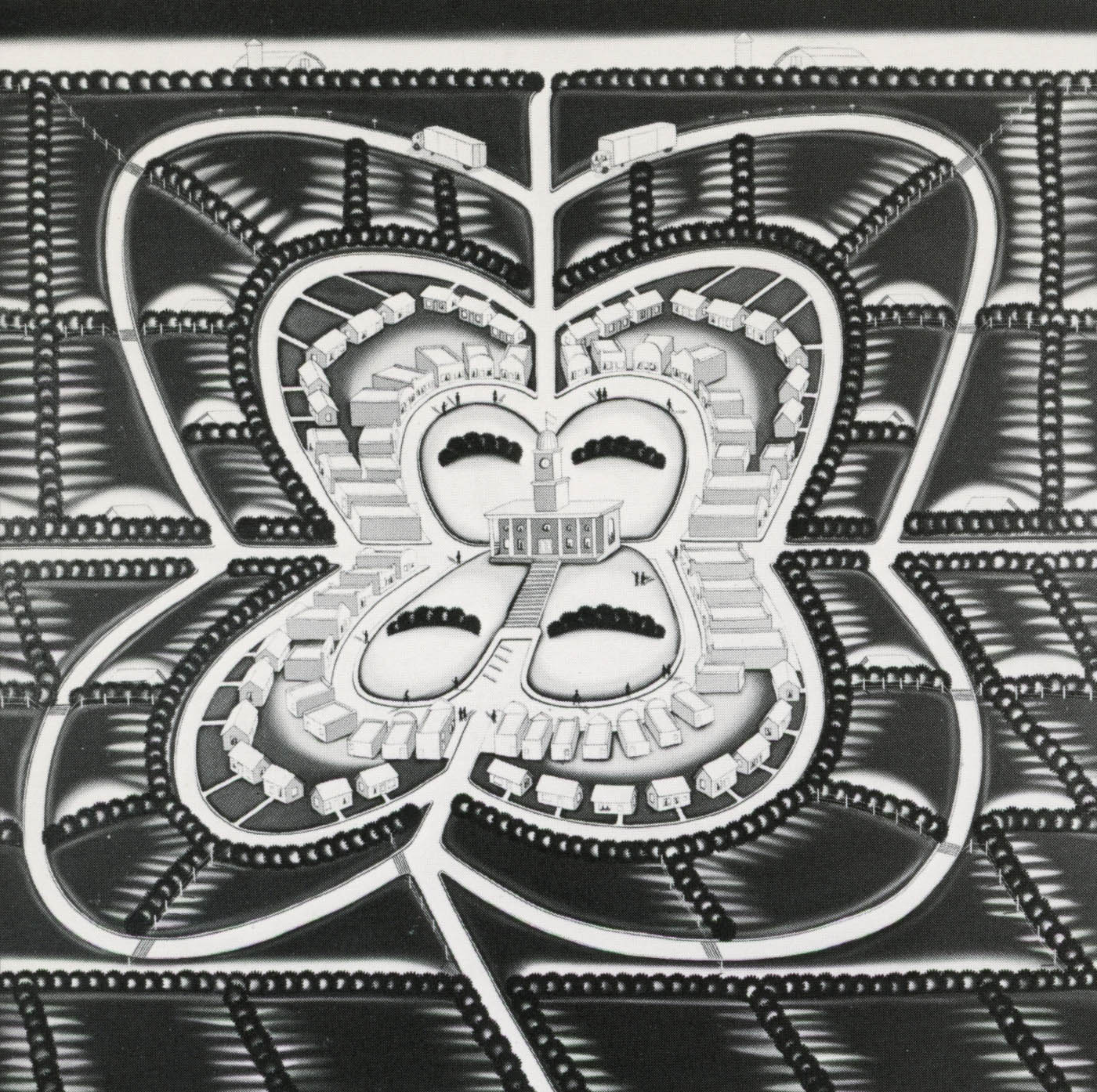
Roger Brown, COUNTY SEAT TRUCK ROUTE WITH CATTLE GUARDS AND BURMA SHAVE, 1975, oil on canvas, 72 x 72 inches, Collection of Jerrold A. Basofin, Chicago
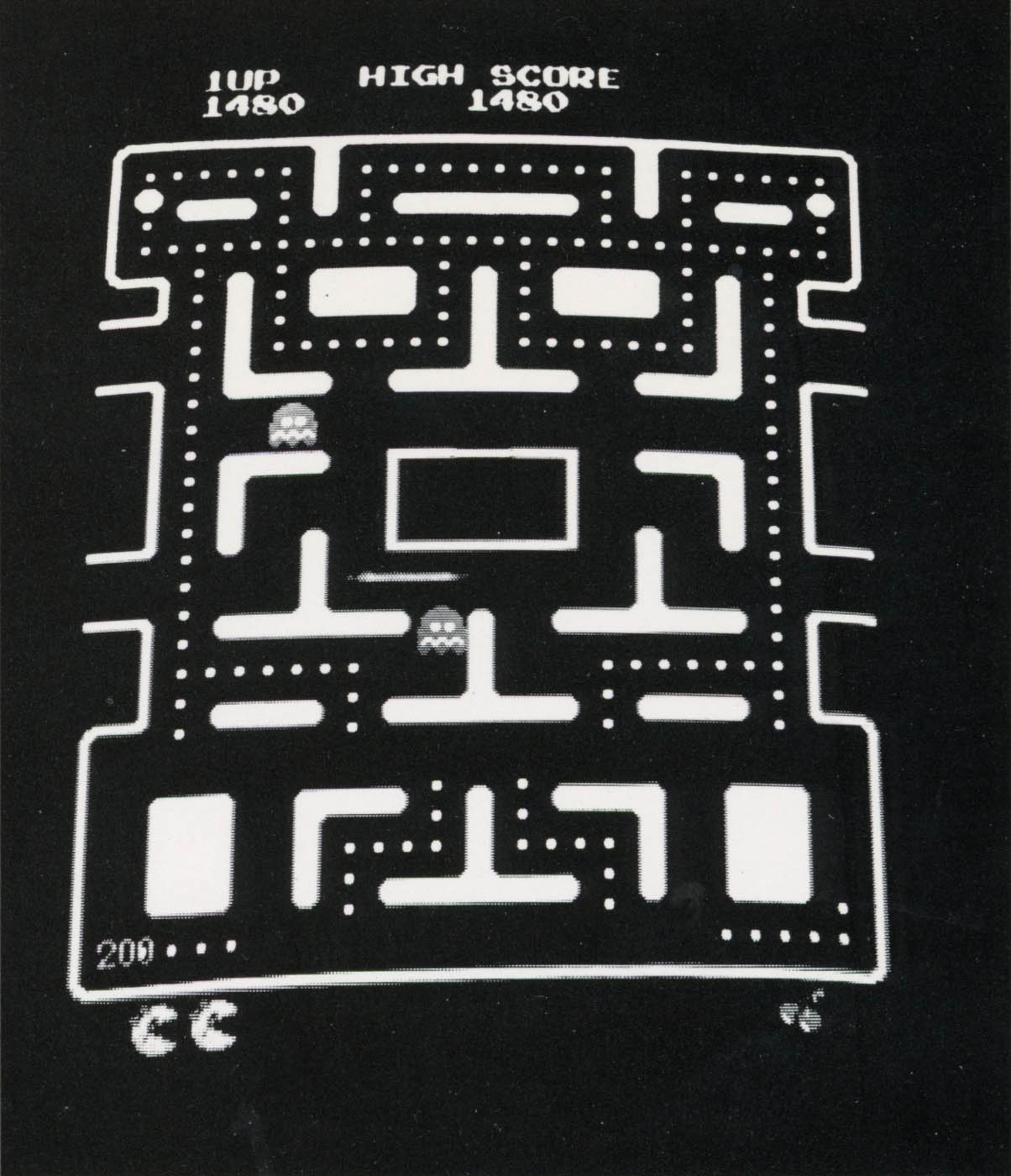
MS. PAC-MAN, © 1982, Midway Manufacturing
In the contemporary video game, the player has become protagonist. The games allow us to adopt the type of roles popularized in television and movies and then play them out ourselves. This is one reason for the video game's success — it provides a new way of overcoming the passivity imposed by television.
The degree of identification between the video game player and his surrogate personality on the screen makes the video landscape of his drama compelling and enveloping. Through the video screen we have become accustomed to seeing — and accepting — certain models of the world. These models can be fertile for the artist and help to give his themes the degree of currency which make them relevant to a contemporary audience. Although there is no direct connection between the vernacular of video games and the work of Nicholas Africano, Roger Brown and William Conlon, they grow out of a similar context of visual models.
Both Roger Brown and Nicholas Africano use cartoon-like imagery ironically to convey a sinister message. In his work of the late seventies, Africano makes explicit allusions to a video screen. In these paintings one or two small, doll-like figures, built of paint and wax, float in the midst of a uniformly painted ground. The figures act out a mute and frustrating drama in the fishbowl of a blank video screen. "An Argument" takes place outside of any explicit context, like a television drama where emotion is simplified and exaggerated. The viewer is a powerless spectator in these paintings as he is in front of a television. Africano's "screen-scape" appropriates a quality of video cuteness that characterizes video games, but transforms it through irony into a moving and unsettling type of imagery.
Roger Brown organizes landscape into a rigidly controlled repetitive pattern. His mazes are peopled by idealized silhouettes — which are visible through the windows of cars and buildings. After continued observation, the mazes begin to overwhelm the viewer with a sense of frustrating circularity. The direction implied by trucks in "Country Seat....," the placement of people at syncopated intervals, and the roadways themselves, create an optical version of Pac-Man's mad chase around his maze. Brown's other paintings often explicitly introduce themes of violence and apocalypse. In the two exhibited here, this feeling is subtly implied by the flat shadowy figures acting in a compulsively ordered context. Brown's vision invites us to see contemporary life reduced to the frustrating repetition of a game like Pac-Man.
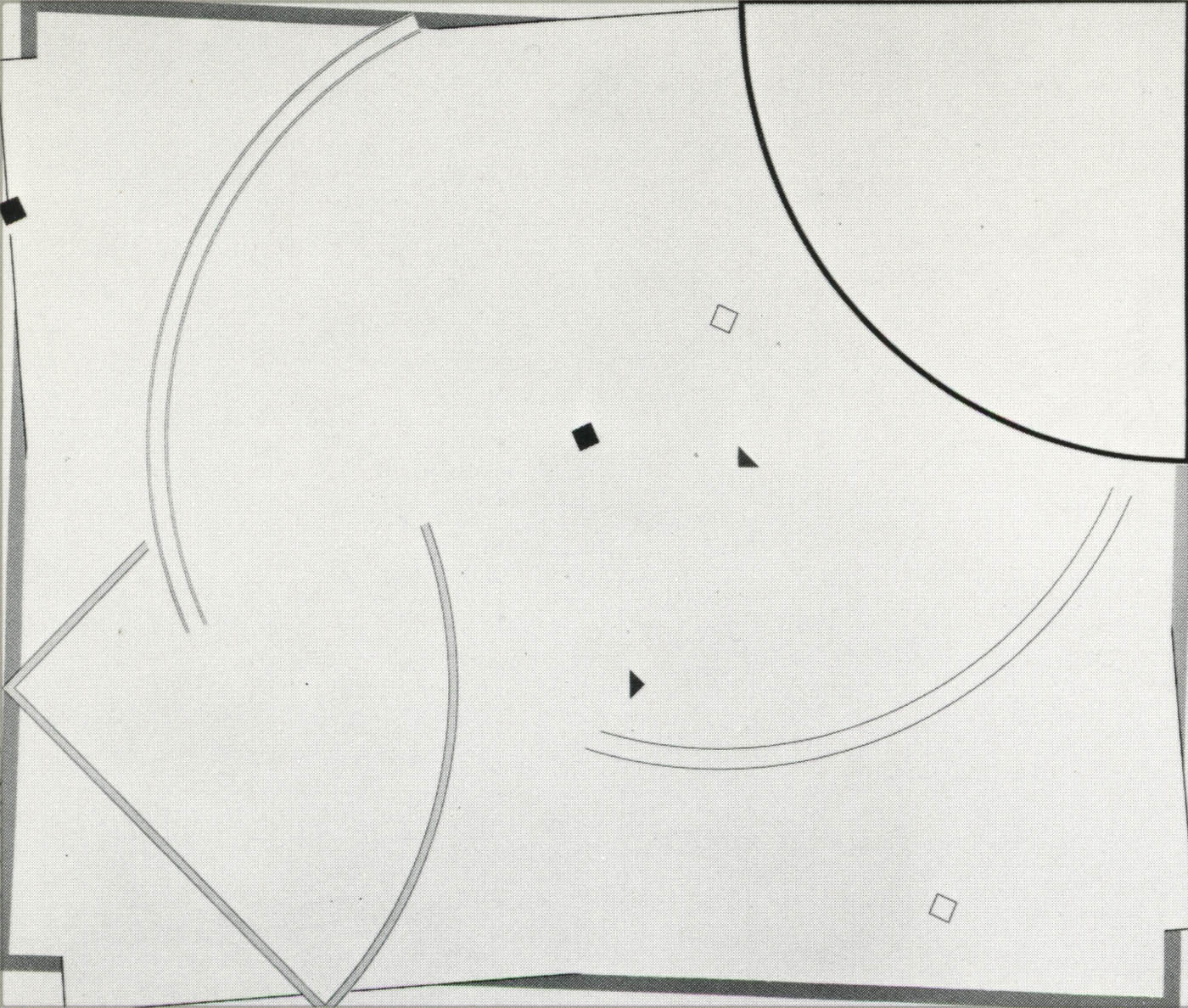
William Conlon, EINSTEIN'S WALTZ II, 1976, acrylic on canvas, 92 x 111 inches, Courtesy of André Emmerich Gallery, New York City
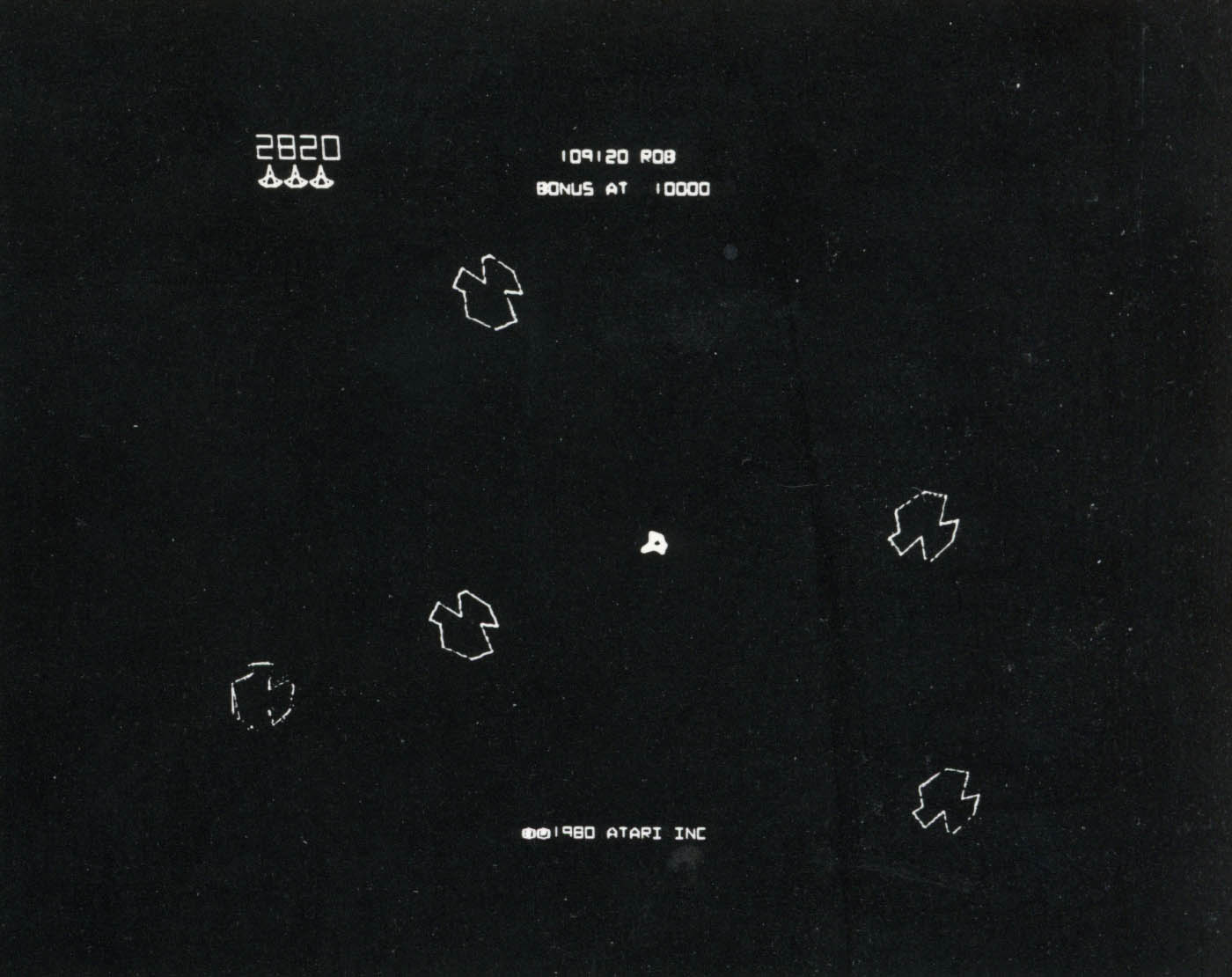
ASTEROIDS, © 1980, Atari, Incorporated
Like Brown and Africano, William Conlon explores a visual model in his art. The exhibited paintings are analogous to the moment in the video game Asteroids when a line form explodes and disappears in a series of pieces. With line and tiny geometric forms against a luminous white field, Conlon creates an exhilarating instability among his forms which is resolved optically. The edges of the painting are delineated by a series of lines which imply a shifting of perspectives. This flickering around the edges is intensified in the center. The corresponding curves and arcs in "Einstein's Waltz II" introduce the notion of a pattern which has been broken apart, but held lyrically together by a compositional balance. Optically, Conlon's paintings work as deep and lively spaces — the eye runs from small form to long arc in a symphony of different speeds and intensities. Conlon builds a "line-scape" which dramatizes optically the kind of events built into a game like Asteroids.
Each of the three painters in "From Pong to Pac-Man" uses a visual language which encourages the viewer to "play" his paintings optically in a way analagous to the video game player. The comparisons established by this exhibition dramatize the correspondences between everyday imagery and the fine arts in a way which makes both more accessible and meaningful to a diverse public.
Footnotes
- Jerry Mander, Four Arguments for the Elimination of Television (New York: William Morrow and Co., 1978) p. 168
- Erik Sandberg-Diment, "The Detective Had So Much To Learn," New York Times, Tuesday, September 14, 1982, p. C2
- Pac-Mania: Top Strategies for Home and Arcade Pac-Man, Editors of Consumer Guide (New York: Beekman House, 1982) p. 42
- Gregg Kilday, "Amazing Atari," Home Video, March, 1982, p. 29
- Robotron, © 1982 Williams Electronics, Narrative teaser of video game.
Lenders to the Exhibition
- Jerrold A. Basofin, Chicago
- William Conlon, New York City
- Phyllis Kind, New York City
- Horace and Holly Solomon, New York City
- Whitney Museum of American Art, New York City
Checklist
Paintings
Arcade Games
Home Games
© Copyright 1982 DeCordova Museum. All rights reserved.
No part of this book may be reproduced in any form or by any means, electronic or mechanical, including photocopying, recording, or by any information storage and retrieval system, without written permission of the copyright owner.