

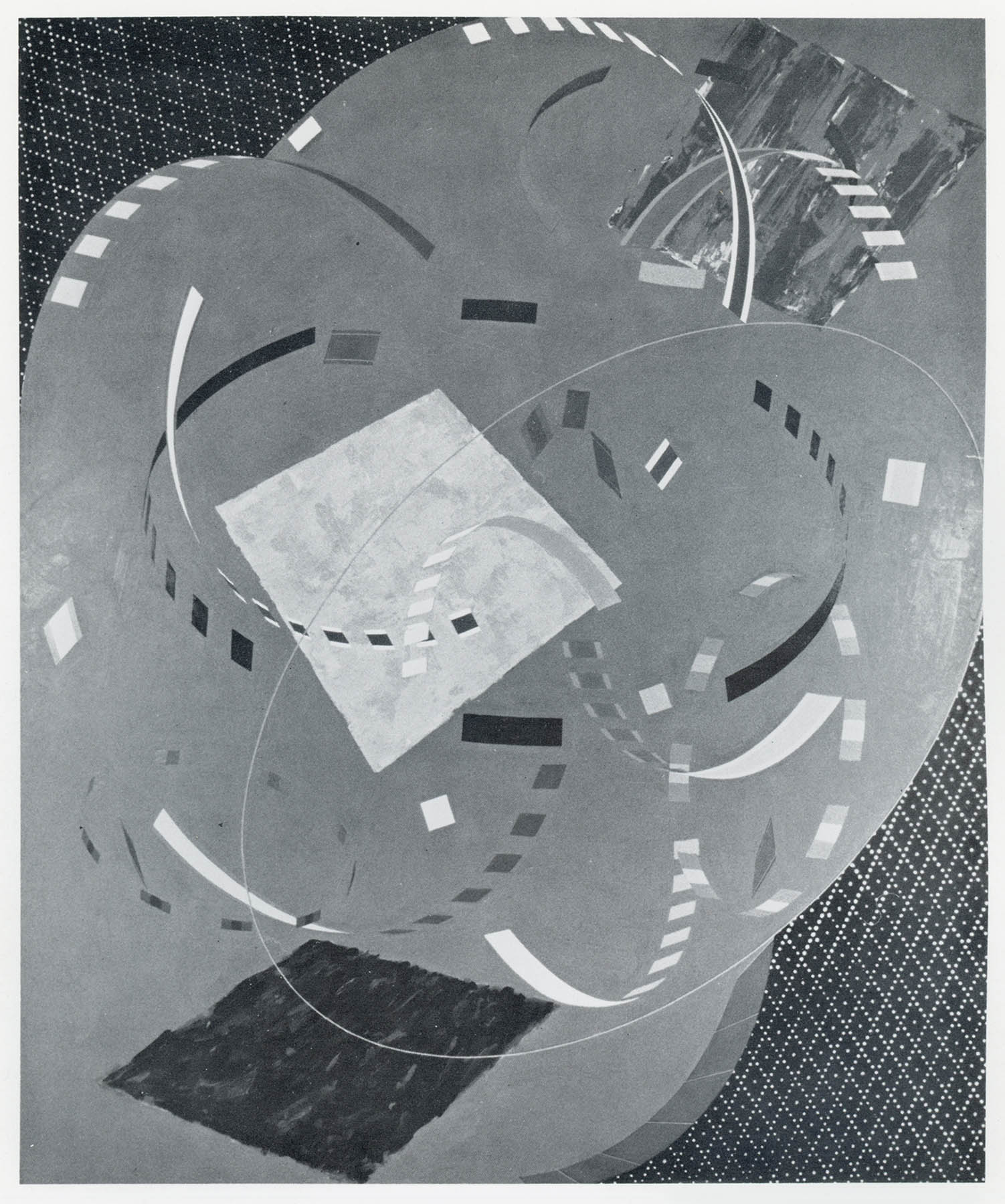
Conversation in a Rain Forest, 1983. Acrylic on canvas, 7′2″ x 6′ (218 x 182 cm.)
William Conlon
New Paintings · January 30 to February 23

André Emmerich Gallery
41 East 57th Street, New York 10022 Telephone (212) 752-0124
An illustrated catalogue with an essay by Robert M. Murdock is available at $10 postpaid.
William Conlon’s
“The Blues Brothers:
Sam and Dave”
William Conlon willfully employs the self-evident means of picture-making to create arresting visual statements which function independently of his cognitive aims.
In art we see the human spirit aroused by reality negating that reality in the creation of a new reality, the work of art. Through the negation of his subject the artist affirms his integration with the universal human spirit. —Stuart Davis
For over a decade, with the attentiveness and rigor of a philosopher, William Conlon has set out to make paintings which, despite their being abstract, are more concerned with the problems of perception and cognition than with the problems about painting. It is perhaps this aspect of his art that is helpful in coming to terms with his work, and also in coming to terms with the problematic issue of painting at present that is called Post-Modernism. Modernist painting, as we have come to know from the critical language we inherited from Greenberg, is a uniquely self-critical enterprise. To speak of painting as self-critical means to see it as the statement and solution of a set of internal problems concerning the nature of painting itself.1
This self-referential and problem-solving aspect of Modernist art is clearly defined in Greenberg’s dictum that each art determines through its unique operations the effects which are peculiar to itself. What makes the practice of abstract painting different in our time, what makes this distinction Post-Modernist, is the manner in which the means of abstraction are utilized. For Conlon these means are put to the service of an important concern: an investigation of our fundamental assumptions of how we perceive the world.
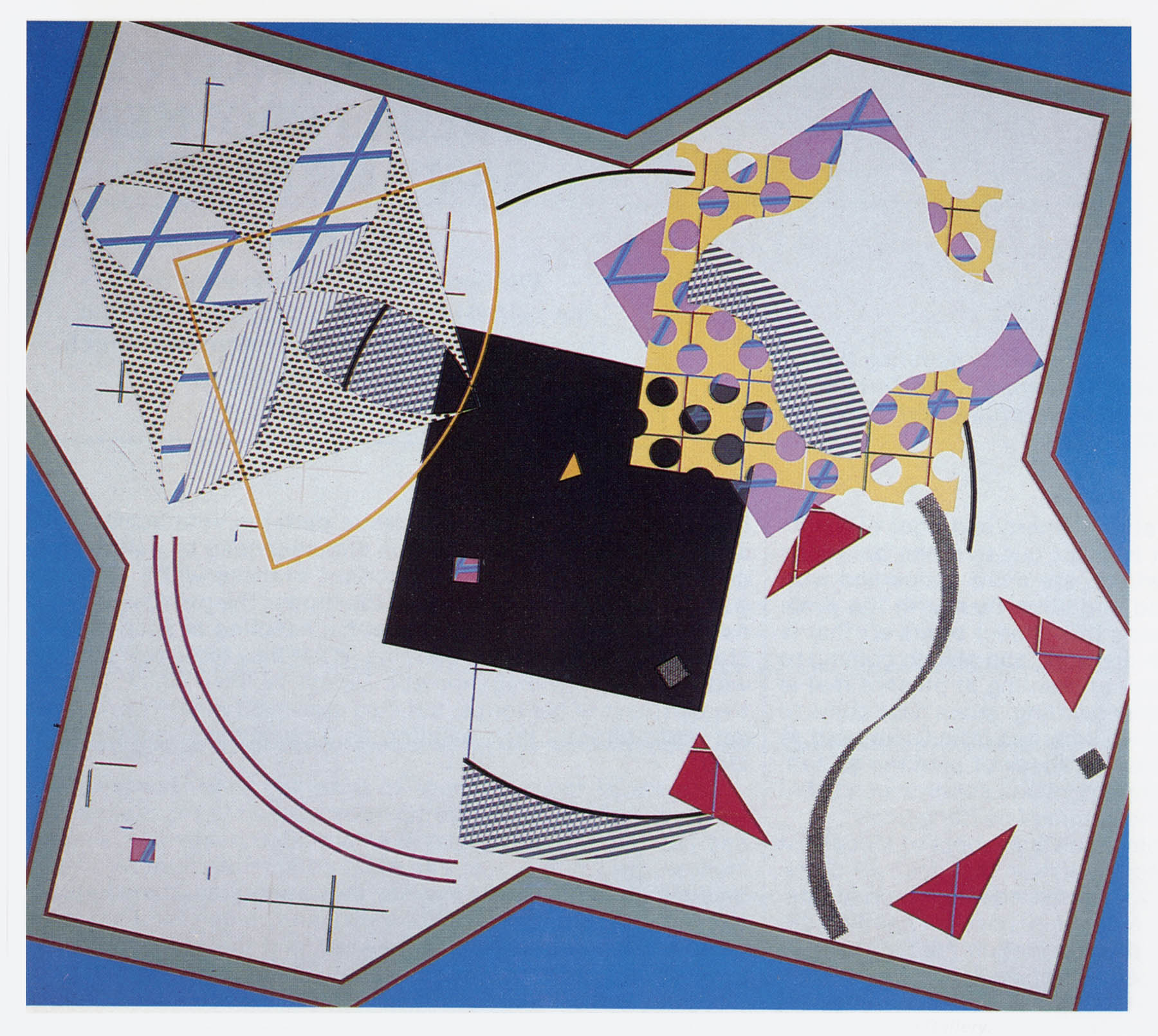
William Conlon’s diptych The Blues Brothers: Sam and Dave is representative of his approach to painting. As a diptych it is essentially two paintings that are to be seen as one. As an aesthetic experience it demands that the formal properties of abstraction—line, shape, color, form—are used to make visual statements that demand of the viewer the usage of cognitive faculties. By cognitive we mean all the mental operations involved in the receiving, storing, and processing of information: sensory perception, memory, thinking, and learning. We must use these faculties in order to unravel the complexities of the painting. The result is an aesthetic experience that uses the optical means of picture making toward a cognitive end. Bill Conlon’s Blues Brothers becomes an experience in visual thinking.
A diptych is a work composed of two matching parts. The crucial word here is matching as opposed to identical. At first viewing, the only difference between them is that one has a dominant white field with a black square at its center, while the other has a black field with a centrally located white square. They are fraternal, not identical twins. Continuous viewing and unraveling of their complexities reveal that in spite of their family resemblance they are as different as night and day, and, as such, are a play on opposites which establishes the central paradox and premise of the work as a unit. The inversion of the states of visual affairs establishes the links, paradoxes, and distinctive features of each panel. But before we discuss how this occurs, perhaps it is best to take into account the pictures as picture and to state compositionally what they have in common as a unit by exploring the visual constituents of which they are composed.
In the mid-Seventies, Conlon began his mature phase as a painter; at this time the language or vocabulary of forms which make up the constituent parts of Sam and Dave began to surface. His paintings of this time were large, easel-size works where the forms of conventional geometry—rectangles, squares, circles, etc.—along with quadrants, a floral form, and a modular form derived from Islamic patterns, interacted in the arena or expanse of white fields circumscribed by painted borders or frames. What was important in these white paintings was the schematic rendering of the forms. The paintings, by the nature of this schematic and graphic handling of shapes, were closer to drawing than to painting. What they took from drawing was not only the diagrammatic aspect of lines which defined the contours of his forms, but also drawing’s innate capacity to act more directly than painting as a purveyor of concept and idea.
In spite of this closeness to drawing, they asserted themselves as paintings. The forms never ceased to resonate as flat and painted shapes held in dynamic interchange and suspension on the white fields. The most compelling feature of their being diagrammatic was the way they attempted to mediate between the flat concerns of notational knowledge (systems, logically constructed and placed events) and the concerns of objects shifting and moving in space. Conlon enhanced the particularity of his forms as flat, yet very concrete, diagrammatic objects by increasing their factual presence as things. This was achieved by executing the paintings in a manner that stressed the sculptural as well as the diagrammatic nature of line. The forms were made by building up and sanding down their surfaces until they were anchored and lodged within the picture plane with the programmatic regularity and precision of inlaid tiles.
The paintings were maps, more specifically, cognitive maps for perceiving the absolute simplicity of shapes interacting in a logically constructed space. That they were schematic brought into play the viewer’s mental or cognitive powers to complete the movements of shape or form, and thereby to identify them as concrete elements or discrete particulars. For example, this was done by the usage of arcs and half-circles which our minds would complete in the negative expanse of the white fields as circles. Conlon did this by appealing to the faculty of memory which enabled us, due to our previous knowledge of circles, to complete his forms. These cognitive maps of objects in space were maps in the diagrammatic or notational sense, and cognitive in that we were forced to use the mental operations of seeing and thinking, reasoning and perceiving, to complete and to recognize their function as forms interacting in space. What they had in common with the concept of map was the notion of the map as analogue.2 The mental operations they demanded of the viewer in perceiving the dynamics of their interactions were analogous to the mental operations we make in maneuvering and discerning the interaction and locations of objects in real space. The white paintings of the mid-Seventies established the language as well as the philosophic and aesthetic concerns of The Blues Brothers. However, its language is expanded upon by an increase of the elements or forms and the addition of color.
In The Blues Brothers, the common language of both paintings expands on Conlon’s previous vocabulary of forms to include dots, an oscillating band or ribbon, rectangles perforated with holes, as well as diagonal and regular grids that function as metering devices to isolate, locate, scale, and proportion the relationships between forms.3 The forms—a floral shape, a [153] quadrant, tilted and overlapping rectangles, arcs and parallel arcs, a dotted oscillating band or ribbon—are set into dynamic interchange punctuated by small rectangles and triangles. The spatial complexity of the paintings is engendered by the usage of overlapping, transparency, and interface, as well as the spatial quality of color which makes these forms appear to advance and recede. Important to both paintings are the frames which circumscribe perception by ordering the parts within each panel. By tilting and moving the frame, Conlon paradoxically sets up two spaces which interact simultaneously. These means continue the intentions of the white paintings but on a more complicated and sophisticated scale.
In the Tractatus, Wittgenstein offers remarks that aid in our understanding of Conlon’s philosophical approach to picture making:
A picture can depict any reality whose form it has.
A spatial picture can depict anything spatial, a coloured one anything coloured, etc.
A picture cannot, however, depict its pictorial form: it displays it.
A picture whose pictorial form is logical form is called a logical picture.
Logical pictures can depict the world.
A picture has logico-pictorial form in common with what it depicts.4
Conlon’s are spatial and colored pictures. They are also logical pictures, in their constructing and ordering, that depict the world, but not in the sense that traditional painting depicts the world. They do not make an appeal to the excavated space of Renaissance painting, which sees the picture plane as a screen on which to project the illusion of a box, a room, a world, but depict the world by presenting their forms as cognitive maps on which we extrapolate our experience of the world. Also, they are not abstract in the Kantian sense as appropriated by Greenberg, but in the completely abstract sense as advanced by Wittgenstein. While it is true that the elements do legislate the formal congress as rules governing the forms that are the means for constructing the picture, their function does not end here. In the chain of statements taken from the Tractatus, one is especially pertinent to Conlon’s aesthetic in The Blues Brothers—“A picture cannot, however, depict its pictorial form: it displays it.”
The key word is not depict, but displays. At this late point in the history of abstract painting, when abstraction is no longer an accepted means of pictorial expression, the notion of display is crucial since it carries with it an attendant sense of the notion of display as presentation. Abstract paintings do display their pictorial form, but by display it is necessary to define what is meant by presentation in a very specific context. If a presentation is defined as the “immediate object of perception, cognition, and memory,” then this is consistent with Conlon’s notion to use the pictorial elements not as self-critical ends, but as presentative and demonstrative ends for a cognitive understanding of perception. To quote Stuart Davis, “A painting is an object in the shape of an organizing idea.” The idea that holds The Blues Brothers together is the notion of paradox as embodied in opposites.
The polar opposites between the two are perceptual differences and actual differences. The perceptual differences are determined by changes that occur in the mind of the viewer which registers them as opposites or differences when in actuality they are the same. These distinctions occur primarily because of Conlon’s masterful manipulation of color—optically, in a manner that is initially pleasing for its decorative appeal, and then engaging as it involves the mind in sorting out the distinguishing features that set the two paintings apart. The color differences between the two paintings, on closer inspection, are immense, especially in light of the fact that they are in actuality the same. They register their differences as optical changes in the viewer’s mind, such that the dominant feel of the color of “Sam” is cool, due to the white ground, while the feel of the color of “Dave” is warm, due to the black of its field. The grays, which are the same in both, are neutralized and made [154] lighter in the dark ground of “Dave,” and heavier with more weight in the light ground of “Sam.” The perceptual shifts add to the irony as what appears to be the same to the mind is made to differ, when in reality it is the same. This is part of the paradox that informs the whole of The Blues Brothers.
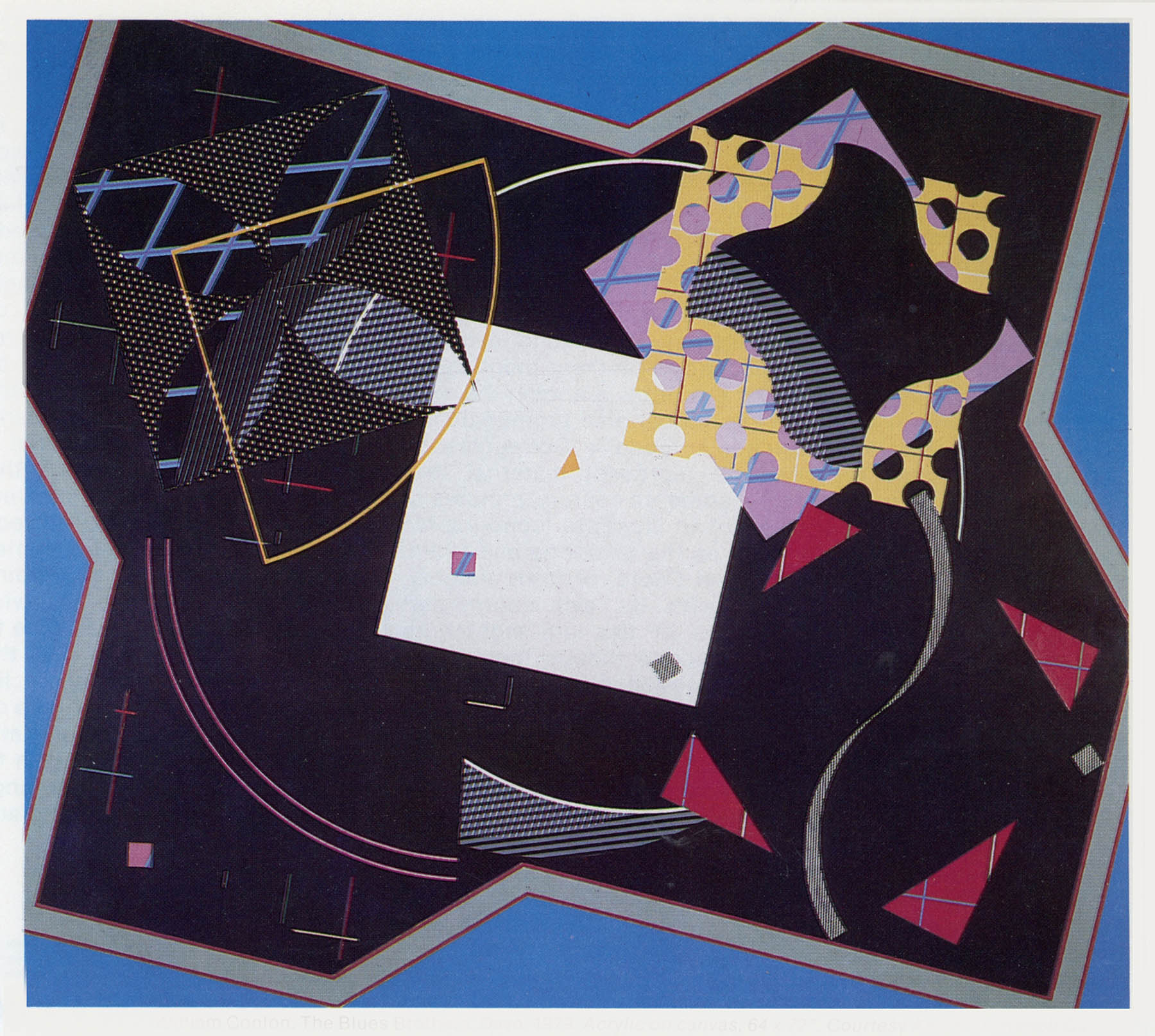
The color changes are important in establishing the perceptual differences between the paintings. Conlon uses design and its principles as means of demarcation and enclosure, along with overlapping, transparency, and interface, to register the actual changes in the two paintings. There are two grids operative in The Blues Brothers. One is blue and diagonal and the other is regular and composed of the primary colors.
The spatial activity of fluctuation and change, location and dislocation, is in part registered by the movements of these grids. But the shift in the motions of the two is the real and most subtle of the actual changes in the painting. Conlon’s use of the grid as a metering device to locate the elements, and his usage of shape simultaneously as shape and contour in the floral pattern, the quadrants, and the Islamic patterns, are crucial to detect the change. By using shape simultaneously as shape and contour, we are made to focus on the edges of the form, and then to make either abrupt or gradual shifts in order to read the areas they circumscribe. This forces shape to function as a kind of lensing action, cluing spatial reading of the forms as the shapes become apertures, or openings, allowing visual passage in, out, and through the forms. The differences in the two grids in the painting are not in their color or scale but in their position, a shift, however subtle, that registers tremendous change. In “Sam,” the blue grid as seen through the opening of the floral shape reveals two of its horizontal bars and a part of its vertical in the lower left-hand opening of the shape, while in the corresponding section of “Dave,” three of the horizontal bars are visible. The same grid seen passing in the tilted pink squares of both pictures registers subtler changes. But it is in the smaller forms, particularly the tiny pink squares located in the large squares at each painting’s center, that the shifts of the blue diagonal grid are most apparent. Both directional and color clues stamp out the motion of the regular grid and signal its actual difference in the two paintings, most clearly seen by comparison of the regular grids which compose the seemingly implied squares in the upper left-hand corners and the tilted red squares of both works.
Memory as agent for the completion and correction of forms, which was one of the major attributes of the white paintings of the Seventies, is used again in The Blues Brothers. The mind is made to follow the arcs to complete circles which are not totally defined but implied. In fact, the paintings require an entire range of mental processes to view them, processes essential to the ingredients of perception itself: active exploration, selection, grasping of essentials, simplification, abstraction, analysis and synthesis, completion, correction, comparison, problem solving, as well as combining, separating, and putting into context.5
The unraveling of these means to see the paintings is a conceptual enterprise but one put to the service of work, one that for all of its mental, intellectual demands and rigors never ceases to function in the decorative arena. Decoration in the hands of an accomplished painter like Conlon is rescued from the pejorative into an affirmative stance. Conlon willfully employs the self-evident means of picture making to create arresting visual statements which function independently of his cognitive aims. However, focusing on the single aspect of the artist’s engagement, with some of the problems concerning the intelligence of visual perception, merely stresses the richness, the amplitude, and the multivalent aspect of his paintings.
- Phillip Fisher, “Hand Made Space,” Arts Magazine (June 1971), pp. 96-101.
- Nelson Goodman, The Languages of Art: An Approach to a Theory of Symbols, The Bobbs-Merrill Company, Inc., 1968, pp. 170-174, 223 ff.
- Jesse Murry, “Bill Conlon,” Arts Magazine (Feb. 1980), p. 14.
- Ludwig Wittgenstein, Tractatus Logico Philosophicus, New Humanities Press, 1921, p. 17.
- Rudolf Arnheim, Visual Thinking, University of California Press, 1969, pp. 13-37.